

Startups fail at web app launches more often than they should, and the culprit is rarely the idea itself. It's the gap between a great concept and the technical decisions that shape it: vague requirements, the wrong stack, or security bolted on at the last minute. Building a scalable, reliable web app requires a clear process, not just talent. This guide walks you through every phase, from sharpening your product vision to shipping a secure, tested product. Whether you're launching your first MVP or rebuilding a product that outgrew its original architecture, you'll find a practical, step-by-step roadmap here.
Table of Contents
- Clarifying the vision and requirements
- Choosing the right architecture and tools
- Building your web app: Agile execution and MVP focus
- Ensuring security, reliability, and launch readiness
- A candid perspective: What most web app playbooks overlook
- Accelerate your web app journey with expert support
- Frequently asked questions
Key Takeaways
| Point | Details |
|---|---|
| Define clear requirements | Start with precise objectives and user stories to keep the project focused and on-budget. |
| Prioritize smart architecture | Choose tech stacks and deployment patterns that balance speed, scale, and maintainability. |
| Iterate with agile methods | Deliver MVPs fast and refine with real user feedback to reduce rework and risk. |
| Secure before launch | Address web vulnerabilities early and verify with defense-in-depth and robust testing. |
| Avoid early over-engineering | Keep initial versions simple and only add complexity when growth demands it. |
Clarifying the vision and requirements
Every successful web app starts with a brutally honest conversation about what you're actually building. Founders often skip this phase, eager to jump into code. That's expensive. Before a single line gets written, you need to align on business objectives, user needs, and hard constraints.
Start with your business objectives. Are you validating a market with a lean MVP? Targeting 10,000 users in six months? Planning for enterprise integrations down the road? Write these down explicitly. Vague goals produce vague products.
Next, capture your functional requirements:
- Must-have features for launch (core user flows, not nice-to-haves)
- User roles and permissions (admin, standard user, guest, etc.)
- Third-party integrations (payment gateways, analytics, CRMs)
- Non-functional requirements like performance targets and uptime SLAs
Then identify your constraints: timeline, budget, regulatory compliance (GDPR, HIPAA, PCI-DSS). These aren't afterthoughts. They shape every architecture decision that follows.
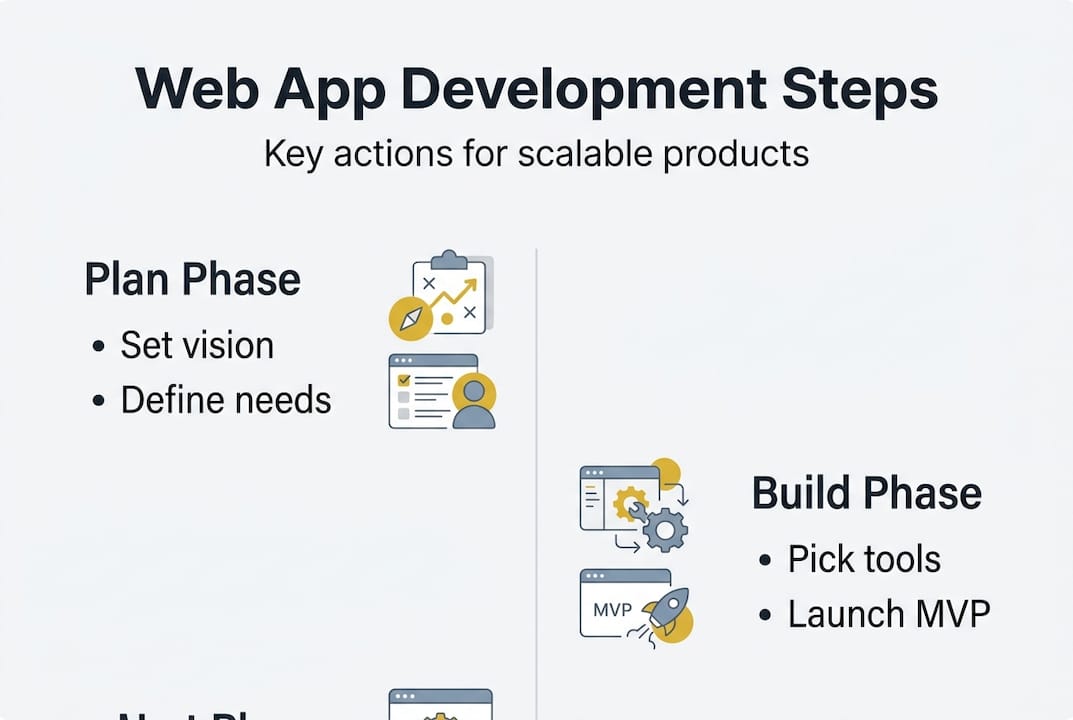
Choosing the right requirements process matters too. Here's a quick comparison:
| Method | Best for | Strengths | Weaknesses |
|---|---|---|---|
| Waterfall | Fixed-scope projects | Clear milestones, predictable | Inflexible to change |
| Agile | Evolving products | Fast feedback, adaptable | Needs strong facilitation |
| Hybrid | Most startups | Planning rigor + flexibility | Requires discipline |
Hybrid agile-waterfall approaches are common in practice because clarity at the planning stage prevents expensive rework later. Most startups benefit from defining a firm scope for the first sprint while keeping later sprints flexible.
Pro Tip: Write user stories in the format "As a [user type], I want to [action] so that [outcome]." This simple structure forces you to think from the user's perspective and keeps minimum viable product planning grounded in real value, not feature fantasy.
Don't underestimate this phase. Teams that rush requirements gathering spend 30 to 40 percent more time on rework. Getting it right here is the single highest-leverage investment you can make before writing code.
Choosing the right architecture and tools
Once requirements are clear, the next step is choosing technologies that enable efficient implementation and future growth. This is where many startups either over-engineer or paint themselves into a corner with inflexible choices.
Here's a practical overview of common stacks:
- JAMstack (JavaScript, APIs, Markup): Great for content-heavy sites, fast load times, and static generation
- MERN (MongoDB, Express, React, Node.js): Flexible, JavaScript throughout, popular for SPAs
- LAMP (Linux, Apache, MySQL, PHP): Mature, well-supported, ideal for traditional web apps
Beyond the stack, your hosting model matters:
- Cloud hosting (AWS, GCP, Azure): Full control, scales well, higher setup complexity
- Serverless (Vercel, Netlify Functions, AWS Lambda): Low ops overhead, great for variable traffic
- API-first architecture: Decouples front-end and back-end, enabling faster iteration on either side
Here's a comparison of the three major architectural patterns:
| Architecture | Scalability | Complexity | Best for |
|---|---|---|---|
| Monolithic | Moderate | Low | Early-stage MVPs |
| Microservices | High | High | Large, distributed teams |
| Serverless | High | Medium | Event-driven, variable load |
For front-end, React and Vue dominate for good reason: large ecosystems, strong community support, and proven performance. On the back-end, Node.js and Python (with FastAPI or Django) cover most use cases. For deployment, Vercel and AWS remain the top picks depending on whether you want simplicity or control.

ISR and edge caching optimize performance over traditional server-side rendering, and technology choices should match your business goals, not just engineering preferences.
Pro Tip: Resist the urge to build a distributed microservices system on day one. Start with a clean monolith on modern development stacks like Next.js and Node.js. You can always extract services later. Complexity added too early kills momentum and burns budget.
Building your web app: Agile execution and MVP focus
With the tech stack in place, it's time to outline a practical approach for efficient, iterative building. The goal of an MVP isn't a half-baked product. It's the smallest version that delivers real value and generates real feedback.
Here's a step-by-step approach to agile execution:
- Sprint planning: Define a two-week sprint scope from your prioritized backlog. Only include features that directly serve your MVP goals.
- Feature prioritization: Use a simple impact-vs-effort matrix. High impact, low effort features go first. Always.
- Rapid prototyping: Build clickable wireframes before writing production code. Validate flows with real users early.
- User testing: Run structured sessions after each sprint. Even five users can surface critical usability issues.
- Refinement: Incorporate feedback into the next sprint backlog. Adjust, don't restart.
Warning: Scope creep is the silent killer of MVP timelines. Every "small addition" mid-sprint compounds into weeks of delay. Protect your sprint scope like it's a contract.
Agile practices enable MVP delivery in four to six months and reduce rework by 30 percent. That's not a small number. It means agile teams ship faster and spend less time fixing mistakes.
Iterative feedback loops are the real engine here. Don't wait for a polished product to show users. Show them rough prototypes. Show them broken flows. The discomfort of early feedback is far cheaper than the cost of rebuilding a feature nobody wanted.
Pro Tip: Create a "parking lot" document for feature requests that come in during MVP sprints. Review it after launch. This keeps your agile sprints guide on track while honoring stakeholder input without derailing timelines.
Ensuring security, reliability, and launch readiness
Once your MVP is feature-complete, attention must shift to preventing vulnerabilities and ensuring scalable, resilient operation before launch. Security is not a feature you add at the end. It's a discipline you practice throughout.
Security checklist before go-live:
- Use parameterized queries to block SQL injection
- Enforce HTTPS site-wide with HSTS headers
- Implement Content Security Policy (CSP) to prevent XSS
- Apply role-based access control (RBAC) across all endpoints
- Set rate limits on authentication and sensitive API routes
- Audit and update dependencies regularly (use tools like Snyk or Dependabot)
Injection and CSRF are among the top risks in web apps, and defense-in-depth strategies paired with OWASP Top 10 checks reduce breach risk significantly. Treat the OWASP Top 10 as your minimum security baseline, not an optional checklist.
Functional and load testing must-dos:
- End-to-end tests covering all critical user flows
- Load testing to simulate peak traffic (tools: k6, Locust, Artillery)
- Regression testing after every major feature merge
- Cross-browser and mobile responsiveness checks
Launch readiness steps:
- Final QA pass with a dedicated tester, not the developer who wrote the code
- Set up monitoring and alerting (Sentry, Datadog, or similar)
- Configure automated backups and a rollback plan
- Conduct a security review against application security best practices
- Define an incident response process before you need it
Pro Tip: Never store authentication tokens in localStorage. Use secure, HttpOnly cookies instead. This single change eliminates an entire class of XSS-based token theft attacks.
A candid perspective: What most web app playbooks overlook
Most guides tell you what to do. Here's what they don't tell you.
Chasing the trendiest stack is a trap. The best technology for your startup is the one your team knows well, has strong community support, and won't leave you stranded when a key dependency goes unmaintained. Stability and talent availability beat novelty every time.
The most efficient teams also threat-model first, before they pick frameworks or cut MVP features. Threat modeling should precede framework selection and feature prioritization. Knowing your attack surface changes which features you build and how you build them.
Authentication is another area where founders get burned. A hybrid approach using JWT for stateless API calls combined with secure session cookies for browser sessions gives you both flexibility and security. Neither alone is the full answer.
Finally, simplicity scales. The real-world case studies that resonate most share one trait: they started simple and added complexity only when the product demanded it. Complicated architectures create maintenance debt that compounds fast in early-stage startups where every hour counts.
Pro Tip: Before your next architecture decision, ask yourself: "Will this still make sense when we have three engineers instead of one?" If the answer is no, simplify.
Accelerate your web app journey with expert support
If you want to turn these steps into launch success and avoid common pitfalls, partnering with experienced developers can accelerate your roadmap significantly.

At KIQA DEV, we bring proven blueprints, hands-on full-stack expertise, and post-launch support to startups that want to move fast without cutting corners. From requirement workshops to production deployment, we handle the technical complexity so you can stay focused on your product and your customers. Whether you need a full build or targeted guidance, explore professional development services tailored to your stage. You can also browse our dev hub offerings for tools, templates, and resources that support every phase of your build.
Frequently asked questions
What is the minimum viable product (MVP) in web app development?
An MVP is the most basic version of your web app with just enough features to satisfy early adopters and validate your core idea. Agile MVPs let startups launch in four to six months with significantly reduced rework.
What is the best project management approach for startups?
Agile methods like Scrum or Kanban are preferred for their flexibility and fast feedback cycles. Hybrids blend planning strengths with agile adaptability, making them effective for startups with some fixed constraints.
How do you secure a web app from major threats?
Protect against injection, XSS, and CSRF by using parameterized queries, HTTPS, and regular vulnerability audits following the OWASP Top 10. OWASP Top 10 checks reduce breach risk substantially when combined with defense-in-depth practices.
When should you invest in scaling or microservices?
Start with a simple monolith and only refactor to microservices when your single app starts slowing down delivery or reliability. Avoid over-engineering MVPs and add architectural complexity only as real usage demands it.
Which architecture yields the best performance?
Incremental static regeneration (ISR) and edge caching are the top picks for balancing speed and scalability in modern web apps. ISR and edge caching consistently outperform classic server-side rendering for most startup use cases.